A chipped or broken tooth does not automatically need a root canal, but damage that reaches the pulp can leave the tooth irreversibly inflamed, dead or infected. By checking the injury, symptoms, test results and restorability together, you can understand when the tooth needs root canal treatment, when it needs another repair, and when delay is unsafe.
Key takeaways
- Seek urgent dental care for an exposed, darkening, loose, or severely painful tooth.
- Pulp tests and dental X-rays help distinguish nerve injury from a repairable fracture.
- A root canal saves a tooth only when its structure can support a lasting restoration.
- Do not place aspirin on an injured tooth or delay care after a major blow.
Which dental injuries can damage the pulp enough to need a root canal?
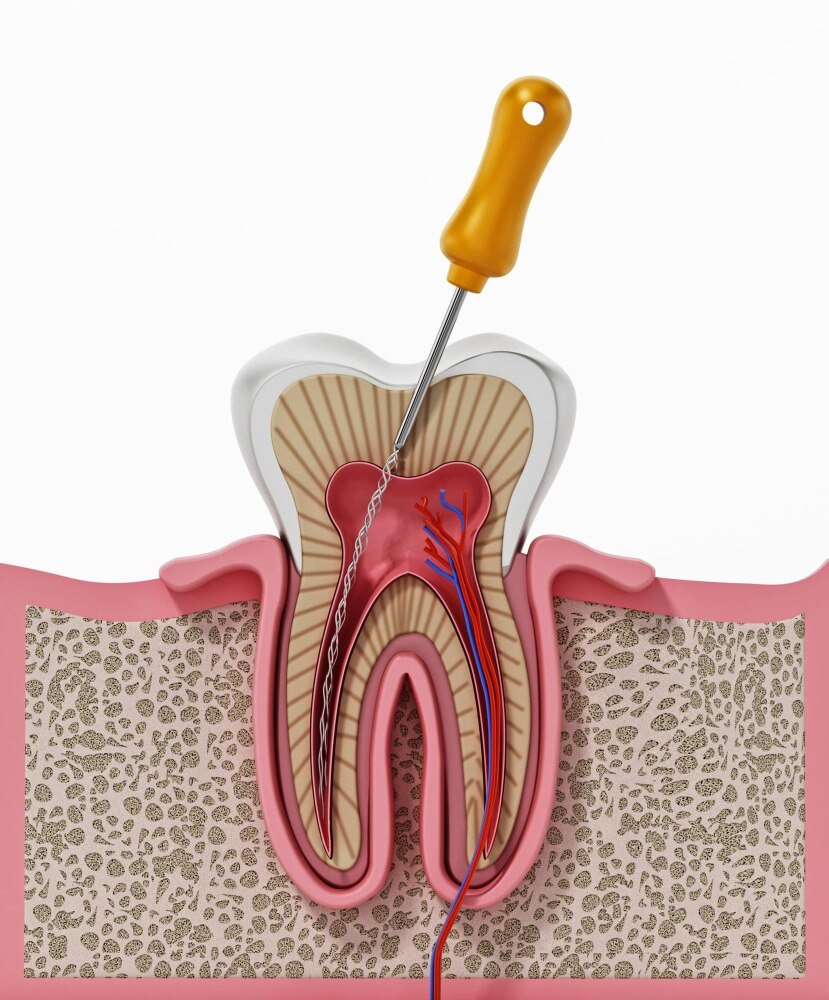
Root canal treatment is needed after dental damage when the pulp—the living tissue inside the tooth—is exposed, irreversibly inflamed, dead, or infected. A root canal for damaged teeth removes this diseased tissue and seals the canals; it does not simply repair a chip or crack.
| Injury | How it can harm the pulp | When root canal treatment is considered |
|---|---|---|
| Deep fracture | The break reaches the pulp chamber | Pulp exposure, irreversible pulpitis, necrosis, or infection |
| Crack into the pulp chamber | Bacteria enter through the crack | Pulp inflammation or infection; the crack still needs protection |
| Large piece broken after a blow | Sudden exposure or disruption of the pulp | The pulp cannot recover or the tooth becomes infected |
| Dislodged or replanted tooth | Blood supply and nerve tissue can be damaged | Necrosis develops, especially in a mature permanent tooth |
| Repeated trauma | Cumulative injury can cause delayed pulp death | Follow-up shows necrosis, resorption, or infection |
A severely injured tooth can still have a recoverable pulp. Vital pulp therapy, sealing, or close monitoring may preserve it when the tissue can heal and the tooth can be restored. Trauma alone does not prove that a root canal is necessary.
Lingering hot or cold pain, spontaneous throbbing, pain on biting, swelling, a gum boil, pus, fever, or darkening raises concern. Symptoms cannot confirm the diagnosis; examination, pulp testing, and X-rays are needed.
Anyone searching “who needs root canal treatment in Dwarka” should ask whether the pulp is vital, irreversibly inflamed, necrotic, or infected—and whether the tooth is restorable.
How can you tell a root canal problem from damage that needs only a repair?
A repair restores the tooth’s shape; root canal treatment removes diseased or dead pulp from inside it. Symptoms cannot make that distinction: a severely fractured tooth may still have a recoverable pulp, while a quiet tooth may already be necrotic.
| Option | What it does | When it fits |
|---|---|---|
| Bonding | Replaces a small missing piece with tooth-coloured resin | The fracture is shallow and the pulp is healthy |
| Filling | Seals a cavity or limited fracture | Enough sound tooth remains and pulp injury is absent |
| Veneer | Covers the visible front surface | The damage is mainly cosmetic and the front tooth is structurally sound |
| Crown | Covers and protects much of the tooth | The tooth is restorable but weakened; after root canal treatment, a back tooth often needs cuspal coverage |
| Repositioning | Moves a displaced or loosened tooth back into position | The tooth is dislodged but has not been judged non-restorable |
| Monitoring | Tracks healing with examinations and repeat tests | Trauma has occurred but the pulp may recover |
| Root canal treatment | Removes inflamed, infected or dead pulp and seals the canals | Irreversible pulpitis, pulp necrosis or infection is confirmed |
Lingering thermal pain, spontaneous throbbing, biting pain, swelling, a gum boil, darkening or pus raises concern, but none proves the diagnosis alone. A root canal for damaged teeth also does not repair a crack; a crack below the gum or into the root can still make extraction the safer choice.
A dentist must assess pulp status, crack depth and restorability before choosing treatment.
What tests confirm pulp injury after a major blow or fracture?
The examination starts with the dental history: when the blow occurred, whether the tooth moved or was knocked out, where the fracture extends, and whether pain, temperature sensitivity or swelling appeared before or after the injury. Previous fillings, crowns, trauma and symptoms in neighbouring teeth also matter.
The clinician then checks:
- Cracks, exposed pulp, missing tooth structure, colour change and mobility; movement is compared with nearby teeth.
- Percussion and palpation, which identify tenderness around the tooth and its root.
- A bite test, often using a small biting tool, to locate pain from a cracked cusp or inflamed supporting tissues.
- Cold testing or electric pulp testing, compared with control teeth, to assess whether nerve fibres respond.
- Periodontal probing around every surface; a narrow, isolated deep pocket can point to a crack extending below the gum or into the root.
- Periapical X-rays from suitable angles, looking for root fracture, widened periodontal ligament space, apical bone changes, displacement or resorption.
One normal sensitivity test does not rule out recent trauma. A shocked pulp can respond weakly or not at all immediately after injury, while a damaged pulp can still respond before it later dies. Repeat testing, comparison with adjacent teeth and follow-up X-rays resolve uncertainty. No single result confirms or excludes root canal treatment.
This is how clinicians determine who needs root canal treatment in Dwarka after major damage.
How urgently should you seek care, and what happens after the first examination?
A knocked-out permanent tooth, a displaced tooth, a severe fracture exposing the pulp, or contamination with dirt should be assessed the same day. Keep an avulsed tooth moist in milk or saline; do not scrub the root. Prompt repositioning or replantation can preserve supporting tissues, but it does not guarantee pulp survival.
- Seek urgent care for spreading facial or gum swelling, fever, malaise, difficulty swallowing, or difficulty breathing. These signs can indicate infection beyond the tooth.
- Arrange follow-up after trauma even when pain settles. A pulp can die weeks or months later, and inflammatory root resorption can damage the root without early symptoms.
- After an avulsed mature tooth is replanted, root canal treatment is commonly required. Timing depends on root development and how long the tooth stayed dry outside the mouth.
The first examination combines the injury history, mobility and crack assessment, sensibility tests, periodontal probing, percussion and radiographs. One normal cold response does not rule out recent trauma.
A dental infection treatment plan may involve drainage and root canal treatment, while antibiotics are reserved for spreading infection or systemic illness, not as a substitute for treating the tooth.
An immature permanent tooth needs a different decision. If the pulp remains capable of healing, the dentist may monitor for revascularisation; if it becomes necrotic, regenerative endodontic treatment or an apical barrier approach can preserve root development. Follow-up examinations and radiographs detect delayed pulp death or resorption.
What must be decided before choosing root canal treatment for a damaged tooth?
Before committing to root canal treatment, decide whether the tooth is restorable and whether testing supports irreversible pulpitis, pulp death or infection. A chipped or painful tooth alone is not enough evidence; the examination should include crack mapping, mobility, periodontal probing, pulp tests and appropriate X-rays.
| Finding | Root canal pathway | Extraction may be more predictable |
|---|---|---|
| Crack | Crack reaches the pulp but remains above the gum and the tooth has adequate structure | Crack extends below the gum, splits the tooth or reaches the root |
| Support | Sound periodontal attachment and enough tooth above the gum for a seal | Severe bone loss, poor periodontal support or insufficient remaining structure |
| After treatment | A posterior tooth can receive definitive cuspal-coverage protection, such as an onlay or crown | No restoration can grip and protect the remaining tooth |
Root canal treatment does not repair a crack. It also does not replace the final restoration: chewing forces can fracture a weakened posterior tooth, so ask when cuspal coverage is needed and which material suits the remaining structure. A crown is not a substitute for proving restorability.
Ask these questions during a root canal treatment consultation in Dwarka:
- What finding proves irreversible pulp damage or infection?
- Does the crack extend below the gum or into the root?
- How much sound tooth and periodontal support remain?
- What restoration follows treatment, and when will it be placed?
- Would extraction and replacement offer a more predictable result?
Antibiotics are not dental infection treatment by themselves. They do not remove infected pulp; drainage, root canal treatment or extraction addresses the source. Antibiotics are reserved for fever, malaise, diffuse swelling, spreading infection or compromised host defences. Dr Pooja Dental & Implant Centre can help structure these decisions alongside a tooth-saving treatment in Dwarka.
Related services
Root Canal Treatment Save your natural tooth and eliminate pain with expert Root Canal Treatment (RCT) at Dr. Pooja Dental & Implant Centre. View service → |
Emergency Dentistry Dental emergencies can be frightening and painful, often happening when you least expect them. At Dr. View service → |
Frequently asked questions
Which dental injuries can damage the pulp enough to need a root canal?
A root canal may be needed when trauma exposes the pulp, causes irreversible inflammation, kills the pulp, or allows infection through a deep crack or fracture.
How can you tell a root canal problem from damage that needs only a repair?
A repair may be enough for a superficial chip or fracture with healthy pulp. Persistent spontaneous pain, prolonged hot or cold sensitivity, pulp exposure, swelling, or a non-vital tooth points to pulp treatment.
What tests confirm pulp injury after a major blow or fracture?
The dentist examines the fracture, checks biting and tooth mobility, compares cold or electric pulp responses with nearby teeth, and takes dental X-rays. Additional imaging may be needed for suspected root or bone fractures.
How urgently should you seek care after major dental damage?
Contact a dentist immediately after a major blow, especially for pulp exposure, uncontrolled bleeding, swelling, severe pain, a displaced tooth, or a tooth knocked out. Early assessment improves treatment choices.
What must be decided before choosing root canal treatment for a damaged tooth?
The dentist must confirm the pulp cannot recover, assess root and supporting-bone damage, determine whether enough tooth remains for a crown or other restoration, and check whether the tooth can be properly restored.
Keywords