Teenagers can be suitable candidates for laser care, but suitability depends on the tooth, gum problem, laser wavelength and treatment goal—not age alone. By comparing laser treatment with drills, scalpels and standard care, and by knowing what to ask before consent, families can judge whether a proposed procedure is genuinely useful.
Key takeaways
- Confirm the diagnosis before choosing laser treatment.
- Lasers treat selected gum, soft-tissue and cavity-related problems.
- Ask about eye protection, anaesthesia, isolation and backup treatment options.
- Compare laser care with drills, scalpels and standard gum treatment for your teen’s diagnosis.
Which teenagers are suitable candidates for laser dental treatment?
Younger teens, older teens and young adults can all receive selected laser procedures after a dentist confirms the diagnosis. Age affects planning because cooperation, anxiety, isolation and eye protection determine how safely the appointment can proceed.
| Age group | When treatment may be suitable | Planning points |
|---|---|---|
| Younger teens | A confirmed, procedure-specific indication | Allow extra time for communication and anxiety management. A parent or legal guardian must understand the indication, alternatives, discomfort, risks and cost. |
| Older teens | The same selected outpatient procedures offered to adults | Many can follow instructions for protective eyewear, isolation, suction and aftercare. |
| Young adults | The exact procedure is appropriate | Assess periodontal health, restorability, occlusion and facial-growth maturity; age alone does not decide suitability. |
Laser dentistry for teens is not one standardized treatment. Diode and Nd:YAG lasers mainly target soft tissue, while erbium-family lasers can interact with tooth structure and soft tissue. Ask for the laser wavelength, tissue target and intended outcome before agreeing to treatment.
Remember that “laser” does not automatically mean injection-free, painless or risk-free. Ask whether local anaesthetic is expected, what conventional treatment would achieve, and why the laser offers a suitable option. This applies when comparing laser dental treatment for teenagers in Dwarka with drills, scalpels or standard gum care.
What teen dental problems can a laser actually treat?
A laser can treat a specific gum, soft-tissue or tooth-preparation problem; it cannot treat “dental problems” as one category. Realistic indications include:
- Gingival contouring or gum reshaping, including uneven tissue around a tooth
- Selected gum-inflammation treatment, alongside plaque removal, periodontal measurements and home care
- Removal of some benign soft-tissue lesions after diagnosis
- Frenectomy, when a restrictive frenum affects movement, speech or hygiene
- Exposure of an unerupted tooth to support orthodontic treatment
- Selected minor surgery, where coagulation, fewer sutures or easier cleaning during healing suits the site and technique
- Cavity preparation with an erbium-family laser, followed by a filling, sealant or another conventional restoration
A laser cannot replace complete caries diagnosis, caries-risk assessment, moisture control or a durable restoration. It does not move teeth orthodontically, treat every cavity, remove an impacted wisdom tooth reliably or handle every case requiring extensive hard-tissue removal.
Photobiomodulation is a separate adjunct marketed for faster orthodontic movement or less pain, but evidence remains uncertain because devices and protocols differ.
For laser dental procedures for young adults, the same rule applies: the indication matters more than the label. Claims about the benefits of laser dentistry Dwarka patients encounter should be tested against the proposed outcome, not assumed from the word laser.
Ask the dentist to switch to rotary instruments or conventional surgery when those options are safer, more complete or more predictable.
How does laser treatment compare with drills, scalpels and standard gum care?
An erbium laser can reduce vibration and the high-pitched handpiece noise during selected cavity preparation, which helps some anxious teenagers. It does not guarantee painless care: decay depth, tooth sensitivity, laser settings and the need for local anaesthetic still matter.
| Option | Comparison | When it applies |
|---|---|---|
| Erbium laser | Less vibration and noise than a drill, but the tooth still needs a durable filling or sealant | Selected, shallow or moderate cavity preparation after diagnosis |
| Scalpel | Precise cutting with more bleeding and possible suturing | Soft-tissue surgery, frenectomy or gum reshaping |
| Soft-tissue laser | Coagulation can reduce bleeding and sometimes suturing | Selected gum procedures and minor soft-tissue surgery |
| Electrosurgery | Uses heat like a laser but has different tissue effects, safety limits and precautions | Specific soft-tissue procedures chosen by the clinician |
| Standard gum care | Plaque control, periodontal measurements, professional debridement and review | Gum inflammation, regardless of whether a laser is added |
Evidence for laser dentistry for teens remains mixed because studies use different wavelengths, techniques and outcomes. Lower noise does not prove a better restoration, and laser treatment cannot replace proper gum care.
Unsuitable energy, pulse duration, cooling or tissue contact can cause thermal injury. Plume evacuation, infection control and wound-care instructions remain necessary after soft-tissue treatment. Eye protection must match the laser wavelength for the teenager, dentist and staff; ordinary glasses are not enough. “Gentle dental treatment for teenagers in Delhi” is not risk-free treatment.
What happens during a teenager’s laser dental appointment?
A teenager’s appointment starts with diagnosis, not the laser. The same sequence applies to laser dental procedures for young adults, although the procedure and tissue target differ.
1. The dentist examines the mouth, reviews medical and dental history, and checks eruption, gum health, decay, restorability and bite. Radiographs are taken when the suspected problem, tooth position or treatment plan requires them.
2. The team explains the diagnosis, alternatives and expected result. Ask which tissue the laser will treat, what conventional care would involve, and whether the laser changes the restoration or surgical step that follows.
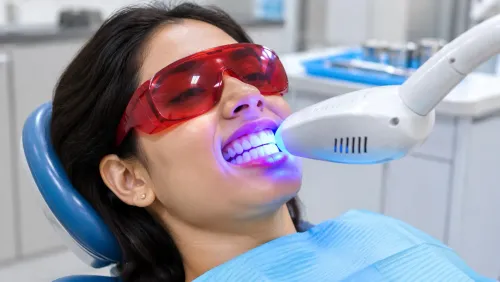
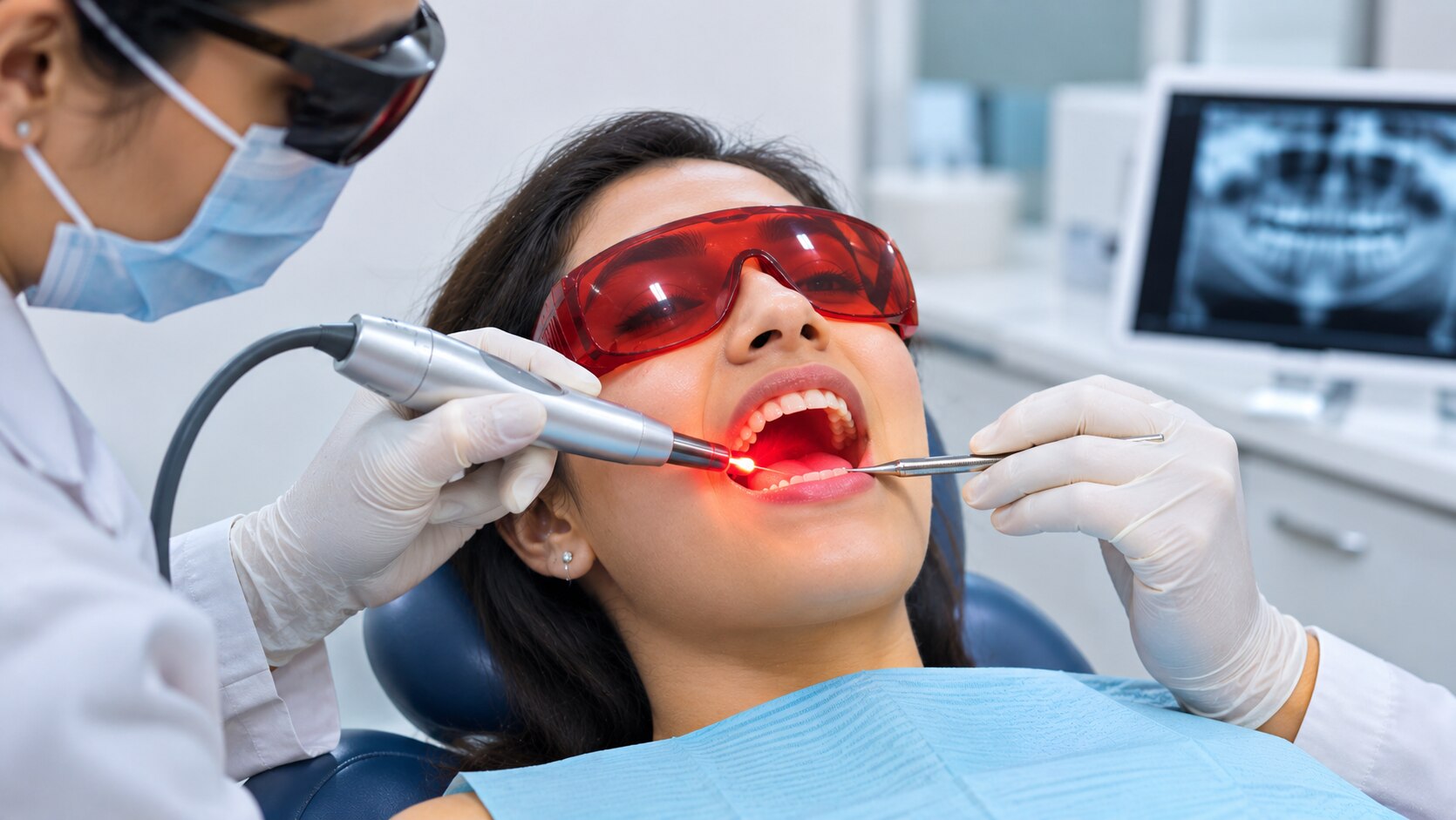
3. During treatment, the tooth or gum is isolated and wavelength-specific protective eyewear is fitted for the teenager, clinician and staff. Local anaesthetic is used when decay is deep, sensitivity is expected or surgery requires it.
4. The clinician applies the laser with settings and cooling suited to the tissue. Suction removes water, debris and plume; poor energy, pulse duration or cooling control can cause thermal injury.
5. The area is cleaned, then the clinician completes any conventional restoration, dressing or orthodontic-related step required. A laser does not replace a filling, sealant or other necessary care.
6. Before leaving, the family receives instructions about brushing, diet, swelling, bleeding, pain relief and warning signs, plus a review appointment when needed.
Shorter visits, less vibration, reduced soft-tissue bleeding or easier hygiene are procedure-specific possibilities, not guarantees. Families seeking gentle dental treatment for teenagers in Delhi should confirm each expected benefit rather than assume “laser” means painless or risk-free care.
What should families ask before choosing laser care in Dwarka?
Do not agree to “laser” as a treatment plan; ask what problem it is solving and what happens if standard care is used instead. Laser dental treatment for teenagers in Dwarka is not one standardised procedure.
| Option | Ask | Why it matters |
|---|---|---|
| Laser | Which wavelength and model? Does it target soft tissue, hard tissue or both? | Diode and Nd:YAG lasers mainly treat soft tissue; erbium-family lasers can treat tooth structure and soft tissue. |
| Conventional care | What would a drill, scalpel or standard gum treatment involve? | It may provide a more predictable or complete result. |
| Combined care | Can the dentist change technique during treatment? | A laser does not replace a filling, restoration, periodontal care or orthodontic step. |
Use this checklist at the consultation:
- Why does this laser suit the confirmed diagnosis, and does evidence support this specific use in teenagers?
- Is local anaesthetic expected, and what discomfort, risks and alternatives should the parent or guardian understand?
- Who will provide wavelength-matched eye protection for the teen, dentist and staff?
- How will suction manage plume, water and debris, and how will cooling prevent heat injury?
- What is the complete sequence, including radiographs, restoration, follow-up and any orthodontic steps?
- What is the total cost, and what aftercare is required? Which swelling, bleeding, fever or worsening pain signs require an urgent call?
At a Dwarka consultation with Dr Pooja Dental & Implant Centre, these questions help families assess a proposed procedure rather than accept “laser” as treatment by itself. Teens can benefit when the indication is specific and alternatives are explained; conventional care remains better when it is more predictable or complete.
Related service
Dental Laser Procedures Experience the future of dentistry at Dr. Pooja Dental & Implant Centre, where we combine advanced laser technology with expert care to provide a... View service → |
Frequently asked questions
Which teenagers are suitable candidates for laser dental treatment?
Younger teens, older teens and young adults can receive selected laser procedures when a dentist confirms the diagnosis and the patient can cooperate with isolation and eye protection. Anxiety, treatment length and the need to remain still also affect suitability.
What teen dental problems can a laser actually treat?
A laser can treat selected soft-tissue and gum problems, assist with some cavity procedures, and manage certain oral lesions. It is not a universal replacement for a drill, scalpel or conventional orthodontic and restorative treatment.
How does laser treatment compare with drills, scalpels and standard gum care?
Laser treatment can reduce contact, vibration and bleeding for selected procedures, but results depend on the diagnosis, laser type and operator. Drills remain necessary for many cavities, while scalpels or standard gum care may suit other conditions.
What should families ask before choosing laser care in Dwarka?
Ask which diagnosis the laser will treat, the laser wavelength and device, whether anaesthesia is needed, how the eyes and nearby tissues will be protected, what alternatives exist, and what happens if laser treatment is unsuitable.
Keywords